
How to make large paellas for many people
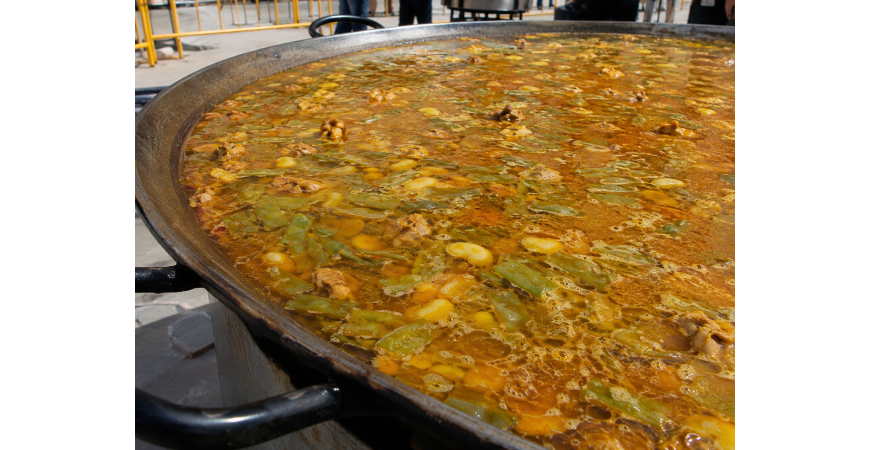
How to make large paellas for lots of people
Preparing a paella for 4 or 6 people is relatively straightforward, but when it comes to making large paellas for 20, 50, 100 or even more guests, things change. You need to calculate the ingredients correctly, choose the right size paella pan, use a burner with enough power and, above all, know how to control the cooking of the rice.
Making a large paella is not simply a matter of multiplying the quantities in a smaller recipe. The larger diameter, the depth of the rice, the evaporation of the stock and the distribution of heat all change the cooking process. In a giant paella, less liquid may evaporate per person than in a family-sized paella, even if the total volume of water evaporated is greater. That is why controlling the heat and the proportions is just as important as choosing good ingredients.
In this guide from Original Paella we explain how to prepare a paella for a large number of people, from choosing the equipment to cooking times, with advice based on our experience making giant paellas for events and celebrations.
What you need before tackling a large paella
Before you start cooking, it is important to organise both the ingredients and the equipment. The more people you are cooking for, the more important it is to have everything ready in advance.
To cook an extra-large paella you will need:
- A suitably sized paella pan: its diameter should allow you to spread the rice in an appropriate layer, without piling it up too thickly.
- A suitably sized and powerful paella gas burner: it should distribute heat evenly and preferably allow you to adjust the rings independently.
- A stable, level support structure: reinforced legs, stands or structures designed for large paella pans; an uneven surface causes stock to collect in one area.
- Ingredients prepared in advance: chopped meat, cleaned vegetables, weighed rice and measured stock before lighting the burner.
- Large cooking utensils: long spatulas, containers for ingredients and tools to help stir the sofrito.
- A safe cooking area: enough room to cook, move around the pan and serve portions, protected from draughts.
- A gas supply suited to the equipment: compatible connections, regulators and gas cylinders, with enough fuel to maintain a steady boil without losing performance.
Calculating ingredients according to the number of guests
One of the first steps in preparing a paella for many people is to calculate the quantities of rice, stock, oil and other ingredients. Although we can multiply the quantities by the number of servings, some elements, especially the liquid, may need adjusting.
Making a paella for 10 people is not the same as making one for 100 or 200. Although a larger pan may evaporate more litres overall, evaporation per serving does not necessarily increase proportionally: if we increase the amount of rice per square metre of pan, less liquid may evaporate per person. Too much water is therefore one of the most common mistakes when preparing giant paellas.
Amount of rice, water and oil per serving
To calculate the amount of rice in a large paella, a useful guideline is between 80 and 100 grams of rice per person, depending on portion size and whether the paella will be the main course.
As for water or stock, there is no fixed ratio that applies to every large paella. Conventional recipes often use a guideline of around 2.5 to 3 litres per kilogram of rice, but automatically applying that ratio to a giant paella may leave us with too much stock. We must distinguish between the liquid absorbed by the rice variety and the liquid lost through evaporation while preparing the stock base and cooking the rice.
For olive oil, we can start with a guideline of 20 to 30 ml per person, adjusting it to the type of recipe and ingredients used.
| People | Rice | Approximate stock | Olive oil |
|---|---|---|---|
| 10 | 0,8 - 1 kg | 2 - 3 L | 200 - 300 ml |
| 20 | 1,6 - 2 kg | 4 - 6 L | 400 - 600 ml |
| 30 | 2,4 - 3 kg | 6 - 9 L | 600 - 900 ml |
| 50 | 4 - 5 kg | 10 - 15 L | 1 - 1,5 L |
| 100 | 8 - 10 kg | 20 - 30 L | 2 - 3 L |
Initial reference table for full servings; it is not a fixed formula for giant paellas. Especially from 100–200 servings upwards, adjust the water to the chosen rice, the depth of the layer, any stock already reduced, the wind and the burner's power.
For more details on ingredient quantities, see our guide to quantities and proportions for making the perfect paella.
Meat, seafood and vegetable proportions for large paellas
When making a paella for many people, we must calculate more than just the rice. Keeping the main ingredients in balance also ensures that every portion contains enough accompaniments.
As a guideline, we can use the following quantities per person:
- Valencian paella: approximately 150 to 200 g of chicken and rabbit per person, allowing for the weight of the bones, plus the appropriate vegetables.
- Seafood paella: around 150 to 200 g of fish and seafood per person, depending on the ingredients used and the amount of shell.
- Vegetable paella: between 150 and 200 g of mixed vegetables per person as a starting point.
- Mixed paella: we can divide the main ingredients between meat, fish and seafood while keeping the flavours balanced.
These quantities are not strict rules. A recipe featuring ingredients with bones or shells will require a higher total weight than one using only cleaned ingredients.
It is also advisable to cut ingredients into similarly sized pieces to make cooking and dividing portions among guests easier.
Practical ingredient example for a giant Valencian paella for 200 people
For a real-world reference, consider a Valencian paella for 200 people, cooked on gas in a 130 cm paella pan. These are the approximate quantities used for a preparation of this size:
| Ingredient | Reference quantity for 200 people |
|---|---|
| Bomba rice | 16 kg (80 g per person; up to 20 kg for larger portions) |
| Virgin olive oil | 4 - 6 litres |
| Chicken and rabbit | 30 kg of chicken and 10 kg of rabbit, chopped |
| Green beans and garrofó beans | 17 kg of green beans and 4 kg of garrofó beans |
| Fresh crushed or chopped tomatoes | 8 kg |
| Water or stock for this preparation | About 42 litres as an initial reference: approximately 32 litres for estimated absorption plus about 10 litres for evaporation |
| Salt, paprika and saffron or food colouring | Adjust progressively to the recipe and the taste of the stock |
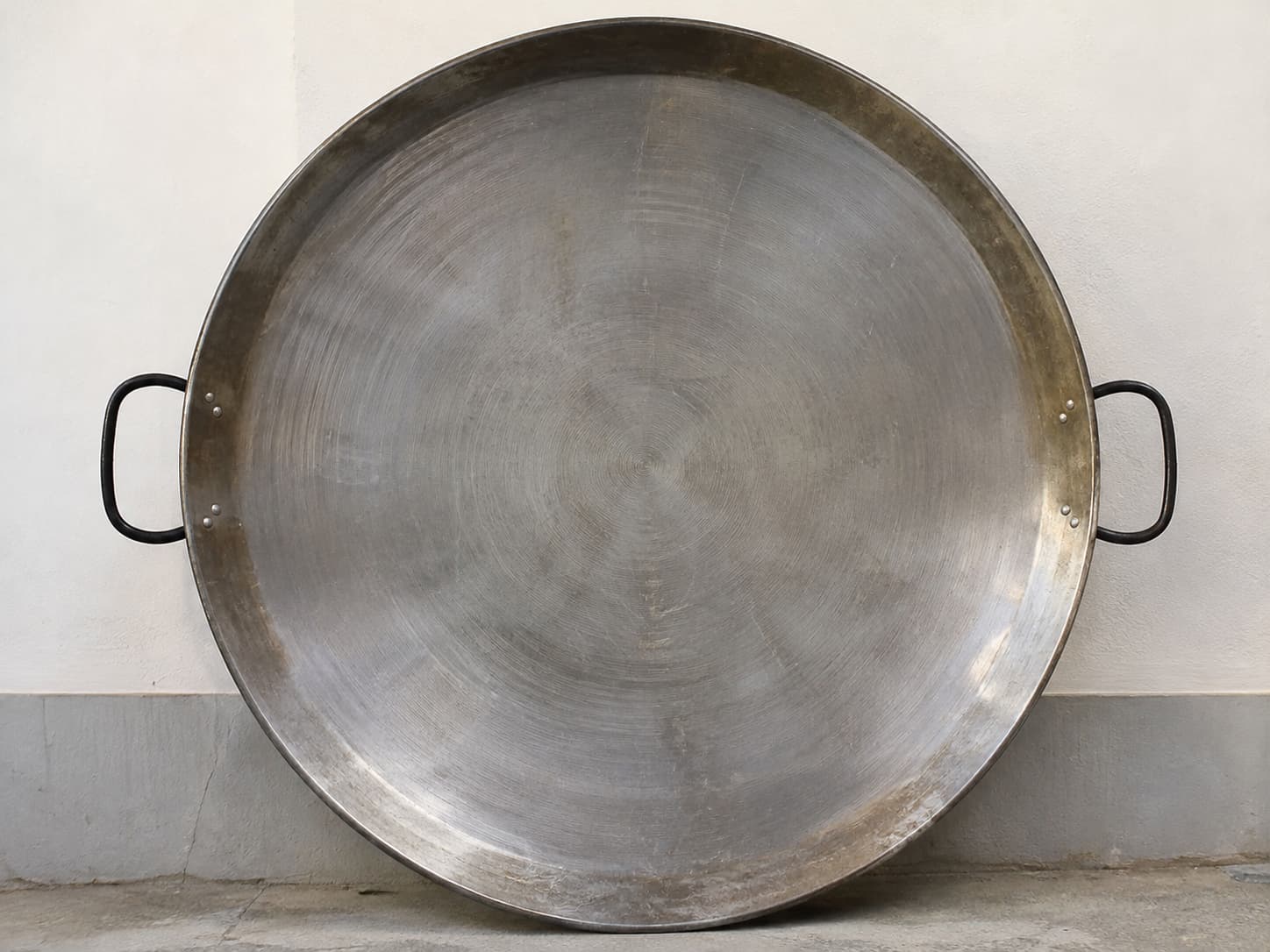
Which burner and paella pan to choose for large quantities
Choosing the right cooking equipment is one of the factors that most influence the final result. A pan that is too small can produce an excessively thick layer of rice, while an underpowered burner can prevent the stock from boiling evenly.
You should therefore choose the pan diameter and burner power together, taking into account both the number of guests and the amount of rice you plan to cook.
Paella pan diameter according to the number of people
A paella pan's capacity depends on its diameter and the depth of the rice layer. At Original Paella, we distinguish between thin-layer preparations, medium capacity and full capacity.
To make a large paella with a relatively thin layer of rice, use the following measurements as a guide:
| Number of people | Approximate diameter | Type of preparation |
|---|---|---|
| 10 | 65 - 80 cm | Thin layer |
| 20 | 90 cm | Thin layer |
| 30 | 100 cm | Thin layer |
| 40 - 50 | 115 cm | Thin layer |
| 60 - 70 | 115 - 130 cm | Thin or medium layer |
| 80 - 100 | 115 - 130 cm | Medium layer |
Guideline table based on the capacities used by Original Paella. The same diameter can provide different numbers of servings depending on the desired thickness of the rice layer.
For larger quantities, such as paellas for 150, 200 or 300 people, there are giant paella pans specially designed for large celebrations and public events. As a practical example, a 130 cm pan has been used to serve around 200 portions, with 16 kg of rice; this does not mean cooking 200 portions in a very thin layer. At these sizes, the actual capacity and the desired rice depth are equally important.
Burner power needed for large paellas
The size of the pan must be matched by a burner capable of distributing heat correctly. In very large paellas, a powerful central flame is not enough: the middle and outer areas also need heating.
The gas paella burners with several independent rings allow you to adjust different cooking zones, making it easier to control the heat while preparing the sofrito, boiling the stock and cooking the rice.
For example, a 60 cm flat-tube burner such as the T600 has three rings and a nominal power close to 20 kW, allowing you to use pans of different diameters depending on the rings in use.
For pans over one metre in diameter, larger professional burners or dedicated giant-paella systems may be needed. In the example for 200 people using a 130 cm pan, a 90 cm, 39 kW professional burner with safety thermocouple valves is used, supported by reinforced legs and accompanied by a long spatula approximately 100 cm in length.
If in doubt, consult our guide on how to choose the right burner size for your paella pan.
Steps for cooking a large paella without overcooking the rice
Once you have calculated the quantities and selected the equipment, it is time to cook. Although the general process is similar to that of a traditional paella, larger formats require special attention to ingredient distribution, heat intensity and timing.
The aim is to ensure that all the rice reaches the correct level of doneness at the same time, avoiding areas that are too dry and others with too much liquid.
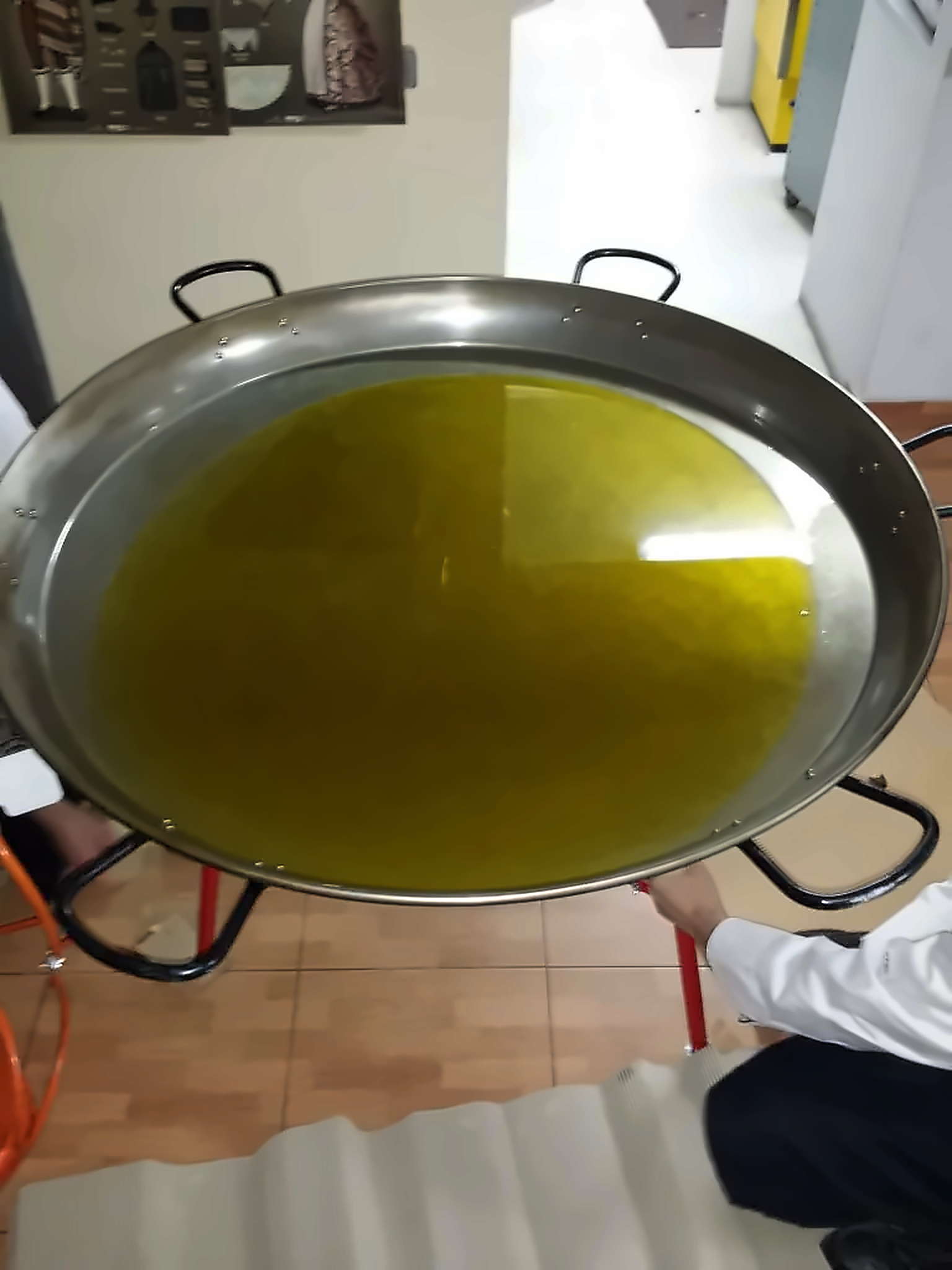
Safe setup and levelling before cooking
For giant gas paellas, first assemble the burner with its legs or reinforced structure, check that the setup is secure and inspect the connections according to the equipment's instructions. High-consumption installations may require feeding the burner from more than one gas cylinder using accessories specifically designed for that purpose, without improvising connections or changing the operating pressure. Protect the installation from the wind, which can extinguish the flame or change the heat distribution.
Before making the sofrito, check the level by adding a small amount of oil to the pan: it should spread evenly rather than collecting at one end. Never leave an empty paella pan over a high-powered lit burner, as it may overheat, warp or become damaged.
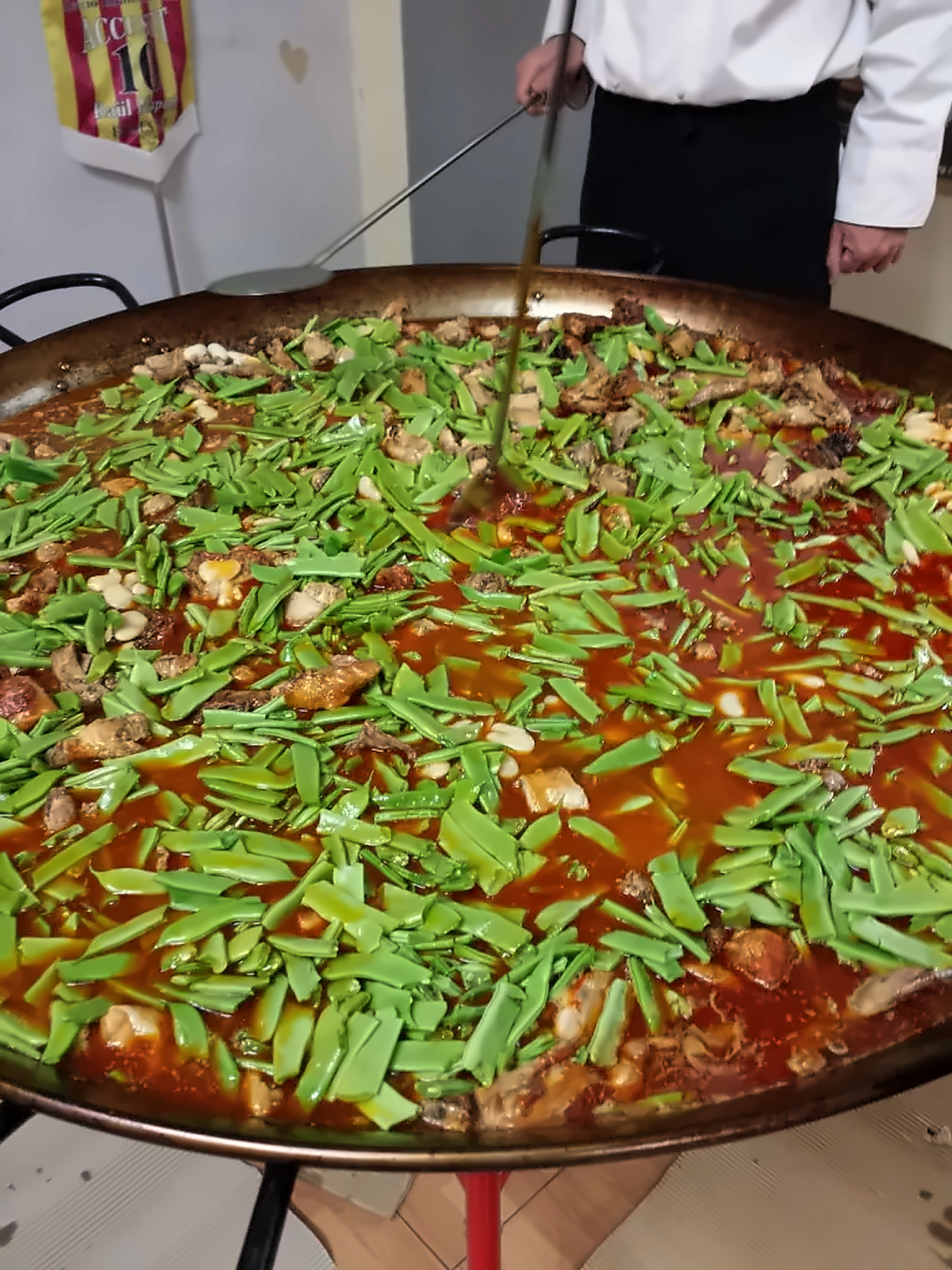
Even distribution of the sofrito and stock
Sofrito is an essential part of any paella, as it concentrates much of the recipe's flavour. In a large pan, it is important to distribute the oil and ingredients properly to prevent some areas from cooking too quickly.
While preparing the sofrito, adjust the flame and use a sufficiently long spatula to move ingredients around the pan. In a large Valencian paella, the chicken and rabbit need to be well browned without burning: this adds flavour to the oil and later to the rice. A spatula around 100 cm long is useful for a 130 cm pan.
Next, add the tomato and sauté it for about 3–5 minutes as a guideline; add the paprika briefly to prevent it from burning. The green beans and garrofó beans can finish cooking in the water while the stock base develops. In the 200-person example, the stock is allowed to develop and concentrate for about 45 minutes before adding the rice; the actual time will depend on the boil, the ingredients and the recipe.
When adding the water or stock, make sure the pan is still level. Otherwise, liquid will collect in one area, affecting how the rice spreads and leaving some parts too dry.
Once the rice has been added, spread it evenly over the entire surface while it is still uncooked and avoid stirring it afterwards. For giant gas paellas around 100–150 cm across, if the rice is distributed well, there is no need to keep moving it; stirring once it is cooking can break the grains and harm the texture. This is different for preparations of thousands of portions with very deep layers of rice, which require specific techniques.
Controlling the heat across a large surface
In a large paella, controlling the heat is particularly important. The greater diameter makes it harder to maintain even heat without suitable equipment.
Generally, heat control can be divided into three stages:
- Preparing the sofrito: adjust the heat to brown ingredients without burning them, paying particular attention to the hottest areas.
- Beginning to cook the rice: maintain a sufficiently lively and even boil so the rice starts cooking uniformly.
- Final stage: gradually reduce the heat when necessary, controlling evaporation so the rice does not end up hard, overcooked or sitting in pools of stock.
Burners with several independent rings are particularly useful because you can adjust the heat distribution to suit each stage.
When cooking outdoors, take the wind into account as well: it can deflect the flame and increase temperature differences between areas.
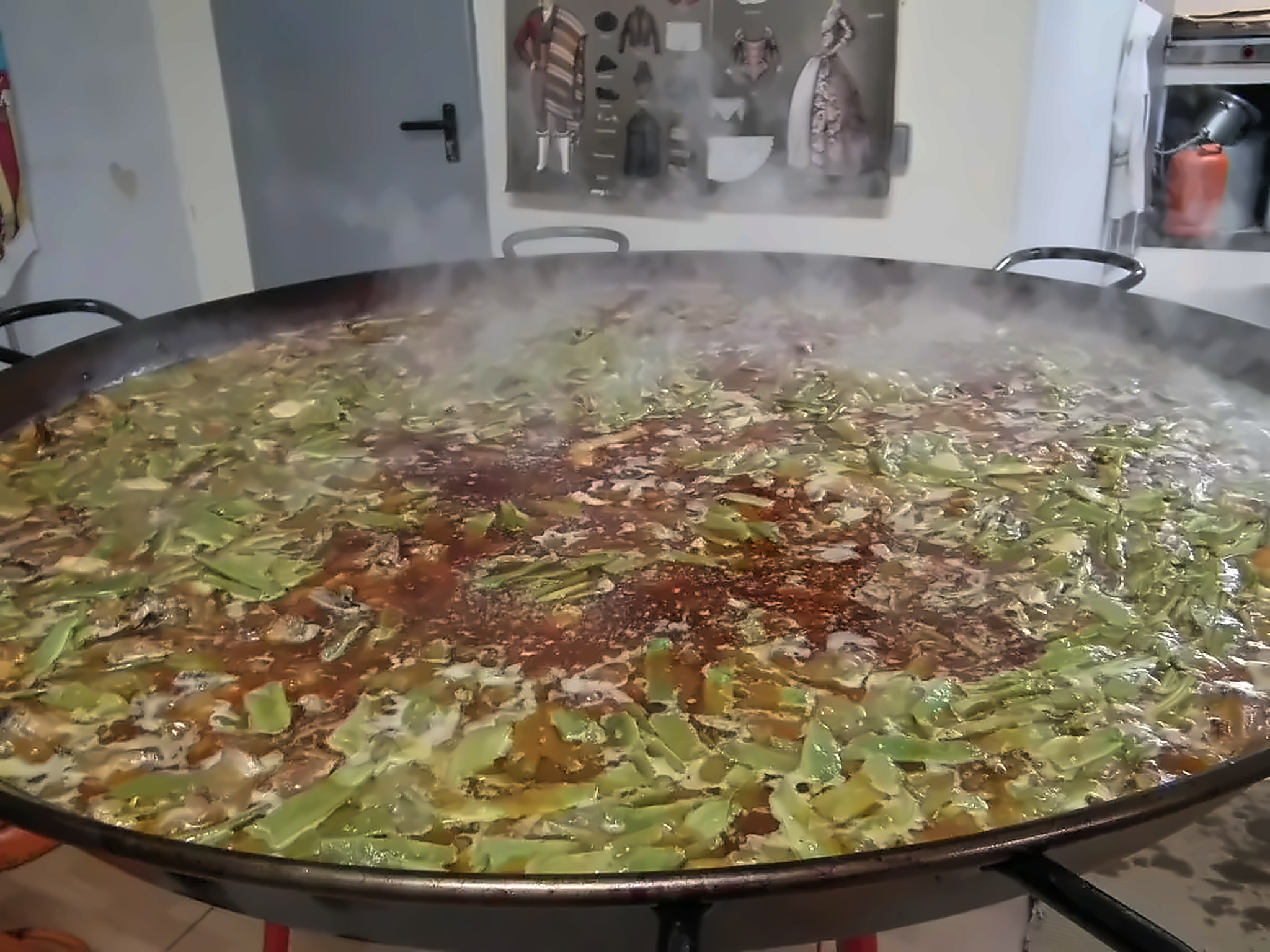
Cooking times for large-diameter paellas
A common question is whether a large paella takes much longer to cook than a small one. The answer mainly depends on the rice variety, available burner power and amount of liquid.
Generally speaking, the rice cooking time does not increase in proportion to the number of portions. If you use the same variety of rice and maintain even cooking, the time may be similar to that of a conventional-sized paella.
As a guideline, many round-grain rice varieties used for paella require approximately 16 to 20 minutes, although you should always follow the manufacturer's instructions and check the grains. In the practical example with bomba rice for 200 people, cooking takes around 18 minutes or less, depending on the doneness achieved, adjusting the heat so that the liquid disappears when the grains are ready, neither before nor after.
What may increase considerably with a large paella is the time needed to brown the meat, make the sofrito and bring all the stock to the boil before adding the rice. You must also consider thermal inertia: a giant steel paella pan retains a lot of heat after the burner is turned off, and the rice may continue cooking, so do not wait until it is completely overdone to turn off the heat.
Common mistakes when cooking for many guests
When making an extra-large paella, small errors that would go unnoticed in a family-sized recipe can become significant problems.
Here are some of the most common mistakes and how to avoid them:
- Using a paella pan that is too small: this creates an overly thick layer of rice and makes even cooking difficult. Choose a diameter suitable for the number of portions.
- Choosing an underpowered burner: this can cause the stock to boil only in certain areas, resulting in unevenly cooked rice.
- Failing to level the pan: this causes the stock to collect in one area, leaving others with less liquid.
- Misjudging quantities, especially water: using too much rice or scaling up the stock from a small paella without accounting for lower evaporation per portion can leave pools of liquid at the end.
- Failing to prepare ingredients in advance: this increases the time between stages and makes the cooking process harder to organise.
- Stirring the rice constantly: this can release starch and spoil the characteristic texture of a dry paella.
- Failing to protect against the wind: cooking outdoors without shielding the burner can cause heat loss, extinguished flames and greater gas consumption.
- Forgetting about residual heat in the pan: especially with heavy equipment, the rice continues cooking after the heat is turned off.
- Heating the empty pan: a high-powered burner can quickly warp it or damage its surface.
- Trying to cook more portions than recommended: exceeding the suitable capacity of a pan does not necessarily produce more satisfactory servings.
One of our most important tips is not to use unfamiliar large-scale equipment for the first time at an important event. If you have no experience cooking at this scale, a trial run will help you understand how the burner performs and how long preparation takes.
Tips for organising a large paella at events
Making paella for a family gathering is not the same as organising a community meal, company celebration or sporting event. When feeding dozens or hundreds of people, planning is just as important as the recipe itself.
Based on our experience making giant paellas for large events, we recommend considering the following:
- Confirm the number of guests: calculate the portions needed and allow a reasonable margin for additional attendees.
- Choose a suitable location: the cooking area should be spacious, stable and allow everyone to work safely around the pan.
- Organise the ingredients: prepare and weigh everything before starting, separating items according to when they will be added to the recipe.
- Check the gas supply: make sure you have enough fuel, appropriate regulators and connections compatible with the equipment; with high-consumption burners, also check that the available gas flow is adequate.
- Plan the schedule: work out when to start making the sofrito so that the paella is ready at the planned time.
- Organise serving: prepare enough plates, cutlery, serving utensils and staff to serve portions without long waits. For 200 people, organise the queues, define entry and exit points and, if necessary, set up several collection stations.
- Consider food safety: avoid leaving cooked rice at room temperature for long periods and organise prompt serving.
- Plan clearing up and cleaning: provide enough waste containers for the event and staff to wash, dry and store the pan afterwards.
For especially large events, it may be worth using several pans at once rather than preparing every portion in a single batch. This will depend on the available space, the number of cooks and the equipment used.
After serving, cleaning is also part of the job: a giant paella pan may require two people to handle it safely. Polished steel paella pans must be cleaned, dried completely and coated with a thin film of protective oil before storage to prevent rust; enamelled and stainless steel pans require the appropriate care for their material.
At Original Paella, we have experience making giant paellas for local festivals, celebrations, companies and sporting events, and also provide giant paella catering services for events.
Where can you find everything needed to make a large paella?
If you are thinking of cooking paella for 20, 50, 100 or more people, at Original Paella you will find all the equipment you need, from large-diameter pans to high-powered burners and specialist utensils.
We offer different solutions for private customers, hospitality professionals, catering businesses and event organisers:
- Paella pans: different materials and diameters for all types of recipes.
- Giant paella pans: extra-large models for celebrations and major events.
- Burners for giant paellas: high-powered burners designed for larger-diameter pans.
- Giant paella catering service: paellas prepared for events by our professional team.
Our team can also help you choose the most suitable equipment according to the number of guests, the type of paella you want to make and the characteristics of your cooking area.
Ready to make paella on a grand scale?
Discover our range of paella pans, burners and accessories for cooking paellas for any number of people.
DISCOVER OUR PAELLA PANS